WELCOME

Welcome and thank you for visiting!

The charts, graphs and comments in my Trading Blog represent my technical analysis and observations of a variety of world markets...
* Major World Market Indices * Futures Markets * U.S. Sectors and ETFs * Commodities * U.S. Bonds * Forex

N.B.
* The content in my articles is time-sensitive. Each one shows the date and time (New York ET) that I publish them. By the time you read them, market conditions may be quite different than that which is described in my posts, and upon which my analyses are based at that time.
* My posts are also re-published by several other websites and I have no control as to when their editors do so, or for the accuracy in their editing and reproduction of my content.
* In answer to this often-asked question, please be advised that I do not post articles from other writers on my site.
* From time to time, I will add updated market information and charts to some of my articles, so it's worth checking back here occasionally for the latest analyses.

DISCLAIMER: All the information contained within my posts are my opinions only and none of it may be construed as financial or trading advice...please read my full Disclaimer at this link.

Dots

* If the dots don't connect, gather more dots until they do...or, just follow the $$$...

Convertible at Beach

Convertible at Beach

ECONOMIC EVENTS

UPCOMING (MAJOR) U.S. ECONOMIC EVENTS...

***2026***
* Wed. Sept. 16 @ 2:00 pm ET - FOMC Rate Announcement and @ 2:30 pm ET - Fed Chair Press Conference

*** CLICK HERE for link to Economic Calendars for all upcoming events.

Showing posts sorted by relevance for query kre. Sort by date Show all posts

Sunday, March 12, 2023

Silicon Valley Bank's Parabolic Rise & Plunge

I initially warned about U.S. bank bubbles bursting on April 10, 2021. My follow-up to that was written on October 15, 2022, which included detailed information on BlackRock Inc.'s (BLK) parabolic plunge.


Since then, we've seen another bank's demise unfold, namely, Silicon Valley Bank (SIVB)...the 16th largest bank in the U.S., and the largest bank by deposits in Silicon Valley.

It's interesting to note how closely SIVB mirrored the movements of Bitcoin, COINFNGU (10 Tech FAANG+ stocks ETF) and BLK, as shown on the following monthly comparison chart. They all rose and fell on parabolic movements...indicating a lack of investor confidence in their ability to retain any long-lasting sustainable value.

Their price action has, essentially, moved in lock-step with the S&P Regional Banking ETF (KRE).

Keep an eye on these in the coming weeks, inasmuch as a collapse in SIVB may trigger a contagion to other banks, including KRE, as well as FNGU, Bitcoin, and other crypto currencies and exchanges.

By the way, major support for KRE sits at 50.00, as shown on the following monthly chart. It's had difficulty holding onto, and adding to, gains made above that level since November of 2016.

A break and hold below could see price drop, in short order, to 40.00, or lower.

P.S. KRE gapped down and opened at 44.47 and hit a low of 41.98 in Monday morning trading...it's currently trading at 44.81 at 1:51 pm ET.

The following ZeroHedge articles provide background and current details on Silicon Valley Bank.


The following daily chart of USDC/USD depicts the de-coupling of the USDC 'Stablecoin' with the USD mentioned in the preceding article...one to watch, as well, for signs of continued or accelerating weakness.

P.S. More updates from ZeroHedge on Silicon Valley Bank...

P.S. Another bank bites the dust...Signature Bank (SBNY) has been closed...the 30th largest bank in the U.S., as of last year. The Wall Street Journal reported that, "Like Silicon Valley Bank, Signature relied heavily on deposits too big for FDIC insurance."

The price action in the following monthly chart of SBNY is pretty much identical to the others noted above.

It looks like all of the DEPOSITORS at SIVB and SBNY will get bailed out by the U.S. Fed and Treasury -- using taxpayers' funds -- as detailed in the following ZeroHedge article...but, INVESTORS will NOT be part of that bailout. Yes, it's really a bailout, and American taxpayers will pay for it, according to this ZeroHedge article.

By the way, depositors with less than $250,000 at Silicon Valley Bank are already insured by the FDIC, so their money is NOT at risk. However, reports indicate that 93% of depositors have OVER $250,000, so Biden is, essentially, bailing out his millionaire and billionaire Silicon Valley buddies, including California Governor Gavin Newsom and his three wine companies! Furthermore, Chinese high-tech start-up companies also had money deposited at SVB, so, they will also be bailed out! And, so, his government is "full of fools to shield men from the effects of their folly," as they "break down American capitalism," as more eloquently detailed in this ZeroHedge report. And, on that topic, Peter Schiff describes how the "latest bank bailout is another nail in Capitalism's coffin" in this ZeroHedge report. In fact, the news seems to be getting worse, as another Biden scandal erupts, as described in this ZeroHedge article.

I thought that after the last massive government bank bailout that occurred post-2008/09 financial crisis (for the banks deemed "too big to fail"), they assured American taxpayers that this would not happen again.

Somebody lied! 

If the Fed STOPS raising interest rates because of this situation, you can be assured that inflation will rocket upward...adding to America's already-bloated national security risks.

Will heads roll at the Fed, including Chairman Powell, as ZH is calling for? After all, they (along with politicians' reckless fiscal policies and over-spending sprees, especially under President Biden these past two years) created the conditions leading to these banking failures, inflation, and chaotic mess!


ZeroHedge excerpt

ZeroHedge excerpt

ZeroHedge excerpt


Mount Printmore

* UPDATE March 13...

Trading in U.S. markets has been volatile and mixed...as traders/investors try to decipher all available information and consult their crystal ball to forecast various fallout scenarios from this hot mess and position themselves accordingly!

P.S. Another bank -- Silvergate Capital Corp. (SI) --  was originally co-founded as a savings and loan association in 1988. The company began providing services for cryptocurrency users in 2016, and conducted an IPO in 2019. In November 2022, concerns were raised about Silvergate's health, following the fall in cryptocurrency prices and the bankruptcy of FTX

On March 8, 2023, the bank announced plans to wind down its operations and liquidate.

The following monthly chart of SI shows the spectacular parabolic spike and plunge of this bank.

This old saying is very appropriate to all things crypto, banks included..."If it's too good to be true, it probably is."

The following ZeroHedge articles provide further details in this regard.


So...that's at least three bank failures in the past week, alone.

The BIG QUESTION is: Are these bank failures a warning signal of systemic weakness in U.S. banks and the banking system, overall? 

This ZeroHedge article provides one point of view on this question.

We'll see what happens in the coming weeks. No doubt, volatility will increase in all markets, for the foreseeable future.

By the waySilicon Valley BankSignature BankSilvergate Bank and First Republic Bank are NOT on the G20's list of 29 Banks Deemed Too Big To Fail. So, why are they getting "bailed out?"

* UPDATE March 14...

Economic data released this morning shows that inflation remains stubbornly high, while real earnings fell, as shown on the following economic calendar.

So, with banks now failing at the Fed's current interest rate of 4.5% to 4.75%, while annual CPI still remains high at 6.0%, (and Core CPI MoM actually rose higher in February) it seems that, on the surface, the Fed will be unable to raise rates any further without fuelling a contagion to other banks around the country. Although, we may still see further bank failures, regardless.

Exactly how the Fed expects to EVER gain control of high inflation is a mystery...especially with President Biden planning on spending $7 Trillion more in his next budget👀

By the way, with smaller regional banks failing, depositors are now fleeing with their money and putting it into the large too-big-to-fail banks, as described in this ZeroHedge report. So, is this really a subsidy of big banks, as alleged? 


By the way, Congress and the Department of Justice need to investigate these bank collapses to determine whether anything nefarious was occurring that could have been prevented, had proper oversight been regularly conducted...then, report the truth to the American people.

American taxpayers (and investors) deserve that much, and more...instead of the gobbledegook currently being sold by the President and his minions (talking-head analysts and the mainstream press)!

P.S. According to this ZeroHedge report, it seems that, "The DOJ and SEC are (separately) investigating the collapse of Silicon Valley Bank, focused on the possibility of misconduct by officers, including whether stock sales by executives violated trading rules."

N.B. This entire mess could have been avoided IF the Federal Reserve had stayed out of meddling with government bank bailouts and interest rates (holding them abnormally low or near Zero% from 2009 until six months after inflation hit with a vengeance in 2021, while engaged heavily in Quantitative Easing monetary policies)...and, instead, let the free market determine fair market value of equities, etc., to prevent overheating of markets and prices of goods and services, as well as tacitly enabling banks to take unmanageable risks on questionable or shaky loans and investments over the past 15 years.

Instead, it seems they've broken the financial markets, to try to stem and reverse Biden's runaway inflation caused by his excessive and unnecessary spending spree of Trillions of dollars over the past two years, as outlined in the following ZeroHedge article.

* UPDATE March 15...

Please see my post regarding Credit Suisse Bank at this link for important information regarding European banking weakness.

* UPDATE March 16...

Please see my post of March 16 regarding another Regional bank failure...namely, First Republic Bank.

* UPDATE March 21...

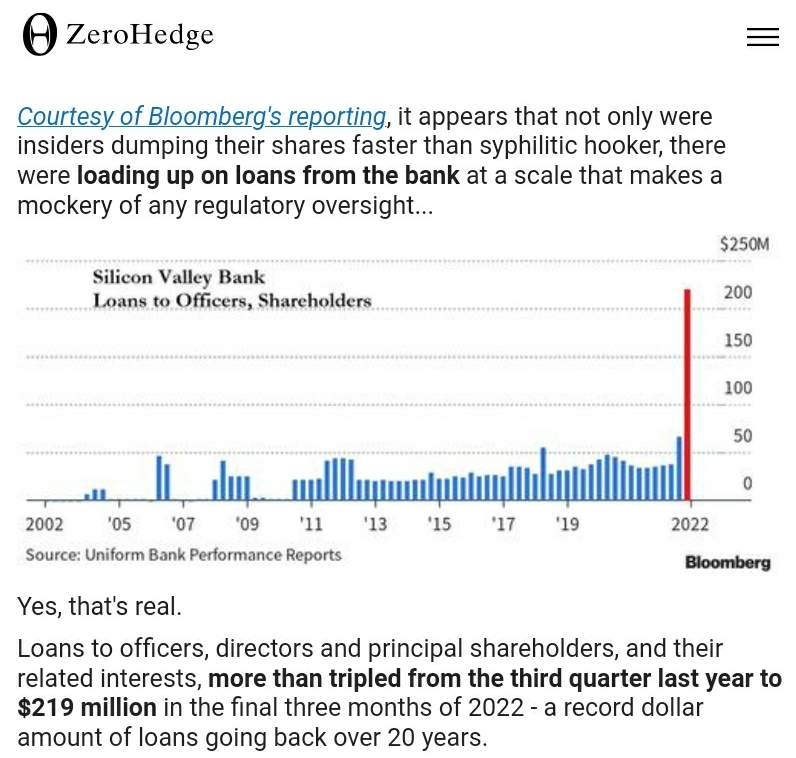
What on earth were Silicon Valley Bank executives, et al, up to in the weeks/months prior to its collapse? 

Will any of their "unusual" activities ever be investigated?

Will anybody be held accountable for any banking violations, if they occurred?

If so, why were they bailed out?


ZeroHedge excerpt

Also, please see my post of March 21, which details the weakness in the KBW Bank Index.


Tuesday, March 21, 2023

KBW Bank Index Looks Shaky

As the U.S. Fed and Treasury Secretary try to assure Americans and the global investment community that their banking industry is secure, the price action on the following monthly comparison chart of the KBW Bank Index (BKX) with the KRE Regional Banking ETF depicts shakiness and incredible weakness, especially during the month of March.

Several regional banks within the KRE ETF have failed, so far, as described in my recent posts here and here. No doubt, we'll see more.

BKX has had great difficulty, since the 2008/09 Financial Crisis, gaining sustained momentum to hold onto gains made above 80.00, and to steadily increase its value...convincingly.

In fact, its current price of 83.65 is considerably lower than that set at its high, immediately preceding the Financial Crisis (121.16 in February 2007). 

Furthermore, it plunged below 121.16 in April 2022 and has been trading lower, ever since...so, it's been weak for a year, now...as has KRE.

Longer-term major support sits at 60.00.

A break and hold below 80.00 could see a retest of 60.00, or lower, in short order.

Sellers are currently in charge of this index, as well as KRE, on this timeframe.

Keep an eye on these two for reaction (immediate and longer-term) to the upcoming FOMC interest rate announcement and Fed Chairman press conference on Wednesday.


Thursday, May 04, 2023

Selling Spreads Across U.S. Regional Banks

* See UPDATES below...

Further to numerous articles that I've recently posted describing the collapse of several Regional Banks, the number of shareholders divesting themselves of shares in other Regional Banks is accelerating.

The following graphic contains a list of the top 10 holdings of the Regional Banking ETF, KRE. All of them are down, so far, today.

KRE has continued its plunge down to the 2020 COVID-19 pandemic median price zone, as shown on the following monthly chart.

Inasmuch as it represents a snapshot of overall sentiment in the regional banks, I'd say the current state of these banks, in general, is pretty weak.

No one should be surprised that this particular sector of banks is weak, inasmuch as I warned about the state of U.S. banks, in general, in my post of April 10, 2021. As it happens at that time, KRE was close to making its all-time high of 78.81 (set in January of 2022), before it began to drop.

Even though its drop was initially choppy, it's been falling off a cliff since March of this year.

It's trading in a large sideways 'Chaos Zone.' It's had difficulty holding onto and increasing its gains made above 30.00 since January of 2013. It's also trading below its IPO opening price of 48.09 made in June of 2006...right before the 2007/08 Financial Crisis.

I anticipate that KRE will bounce around within that 'Chaos Zone' for some time. However, a drop and hold below 30.00 would signal much more serious consequences for the entire banking system, not only in the U.S., but globally, as well...as occurred in 2007/08/09.

N.B. Given these facts, it's odd that Fed Chairman J. Powell still insists that these banks are secure, when their representative ETF is plainly portraying great weakness...below that leading up to the 07/08 Financial Crisis

Surely one has to wonder if that contagion will spread to the larger banks and the 29 banks deemed too-big-to-fail by the Financial Stability Board of the G20 in 2011. Note that Credit Suisse did, subsequently, fail, as described in my recent posts.

Today's ZeroHedge article has some answers in that regard.

* UPDATE May 5...

And...(lots of) food for thought...(HINT: keep your money safe!)...


(Editor's Note: SATIRE 😏)

* UPDATE May 6...

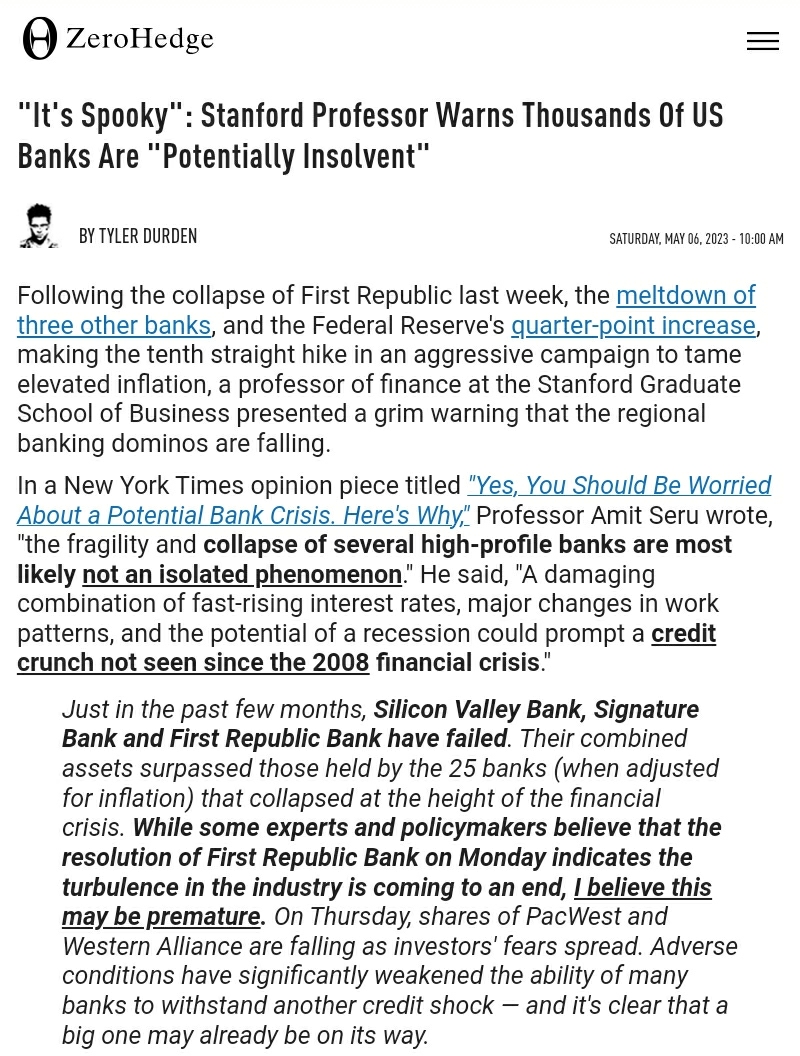
"It's spooky. Thousands of banks are underwater.

Let's not pretend that this is just about Silicon Valley Bank and First Republic. A lot of the US banking system is potentially insolvent."