WELCOME

Welcome and thank you for visiting!

The charts, graphs and comments in my Trading Blog represent my technical analysis and observations of a variety of world markets...
* Major World Market Indices * Futures Markets * U.S. Sectors and ETFs * Commodities * U.S. Bonds * Forex

N.B.
* The content in my articles is time-sensitive. Each one shows the date and time (New York ET) that I publish them. By the time you read them, market conditions may be quite different than that which is described in my posts, and upon which my analyses are based at that time.
* My posts are also re-published by several other websites and I have no control as to when their editors do so, or for the accuracy in their editing and reproduction of my content.
* In answer to this often-asked question, please be advised that I do not post articles from other writers on my site.
* From time to time, I will add updated market information and charts to some of my articles, so it's worth checking back here occasionally for the latest analyses.

DISCLAIMER: All the information contained within my posts are my opinions only and none of it may be construed as financial or trading advice...please read my full Disclaimer at this link.

Dots

* If the dots don't connect, gather more dots until they do...or, just follow the $$$...

Beach Drinks

Beach Drinks

ECONOMIC EVENTS

UPCOMING (MAJOR) U.S. ECONOMIC EVENTS...

***2026***
* Wed. June 17 @ 2:00 pm ET - FOMC Rate Announcement + Forecasts and @ 2:30 pm ET - Fed Chair Press Conference

*** CLICK HERE for link to Economic Calendars for all upcoming events.

Showing posts with label Market Chaos. Show all posts

Friday, June 05, 2026

BITCOIN: Chaos

Bitcoin in a nutshell...CHAOS...over and over again.

Not for the faint of heart! 🤢


UPDATE:

Bitcoin's extreme volatility renders it unsuitable for normal technical analysis, as has been done in the following report.

IMHO it's simply an overhyped kleptocurrency...as are the rest of these cryptocurrencies.


Thursday, April 10, 2025

SPX ALERT: Potential Retest of 200 MA Along With A Death Cross Event

While it's not a guarantee, it's not uncommon for the the S&P 500 Index (SPX) to bounce after a significant drop and retest its 200 MA, following the formation of a bearish moving average Death Cross.

We may be at that point, as the 50 MA is poised to drop below the 200 MA in the next couple of days, as shown on the following daily chart.

As you can see, the SPX has plunged a great deal since it reached its high of 6147.43 on February 19 in connection with President Trump's global tariff war, before reversing and spiking following its low of 5069.90 on April 4. It closed today at 5268.05 in a very large and volatile trading range.

A spike to around 5750ish to retest its 200 MA is possible (and close the gap down between April 2 and 3), given that the RSI, STOCH, and MACD indicators are hinting of such a scenario -- and that volatility is extreme, as shown on the following SPX:VIX daily Ratio chart -- before resuming its downtrend.

With the drama of Trump's day-to-day tariff/trade flip-flops, anything's possible, so we'll see what happens.

SPX Daily chart

SPX Daily Ratio Chart


Friday, March 31, 2023

SPX: Mired In Volatile 'Chaos Zone'

It's plain to see that the SPX is firmly stuck in between 3750 and 4200 (a very volatile, whippy 'Chaos Zone') as noted on the following daily chart.

It's had difficulty gaining sustained momentum to hold onto gains made above 3750 and steadily increase its value, convincingly, since January of 2021.

A breakout and hold above 4200 could see a retest of its prior high of 4818.62 (hit on January 4, 2022).

Otherwise, a break and hold below 3750 could see a retest of 3500, or lower, to around 3000.

N.B. Unless absolute proof is produced to investors and traders that the entire U.S. banking system is safe and secure, including Regional banks, any breakout above 4200 could be considered shaky and short-lived...especially with inflation still near 40-year highs, the U.S. Fed still raising interest rates, and a recession looming this year (or, more likely, stagflation).


Friday, December 23, 2022

2022 Market Wrap-Up: 'Like Watching Paint Dry'

The May 2022 'long-legged doji' foretold how the second half of the year would unfold on the S&P 500 Index (SPX)...with choppy, volatile indecision.

As shown on the following monthly chart, the price has, essentially, traded sideways in a large trading zone, between 3500 and 4300.

It's bounced back and forth between Buyers and Sellers, like a yo-yo.

As it's turned out, any gains, either on the long or the short side, have been short-lived...much like the first half of 2022 was.

Day-to-day or week-to-week trading for 2022 has been erratic and non-directional...and about as interesting as 'watching paint dry.'

Unless you took profits during the December 2021 candle -- which followed November's bearish 'shooting star' (which wasn't confirmed until January's 'bearish engulfing' candle) -- and, either, shorted the markets and held, or, simply stayed out, you were caught up in this slow slip downwards, dominated by choppy large-scale sideways consolidations.

As I mentioned in my post of December 21, we may see a fourth 'candy cane' form in January 2023, with a price target of 3200...if Sellers remain in control.

We'll see what happens.

I hope to post my Annual Forecast for the New Year in the next few days, so stay tuned. As a reminder, my 2021 Market Wrap-Up & 2022 Forecast can be read here.


Tuesday, August 16, 2022

WTI CRUDE OIL: Trading In A Chaos Zone

* See UPDATES below...

In my post of March 2 regarding WTI Crude Oil, I mentioned that my previous price Targets 1 and 2 (100.00 and 111.00-112.00), which I'd identified in my prior post of February 24, had been hit...and that Target 3 (147.27) still remained intact.

However, just days later, price hit a high of 130.50 on March 7...not quite tagging Target 3, but coming fairly close...before chopping around that level, then beginning a drop to current levels, as shown on the following monthly chart. 

Note that an extreme spike formed by the end of March on the ATR indicator...hinting that a price turnaround may be imminent. As I did in my March post, I've shown the ATR with an input value of one period to clearly illustrate that such a spike occurred that month.

Price is stuck, again, within, what I've dubbed a 'Chaos Zone,' in between 80.00 and 100.00

Previous attempted breakouts above this zone have been short-lived, since January 2008. In fact, those breakouts have all been followed by a large drop to retest long-term major support at 40.00.

Whether price drops to 40.00 any time soon, is anyone's guess. If it does, watch to see if the ATR forms another extreme spike to signal a potential price reversal.

However, if such a spike occurs at any price above that level on the monthly timeframe, a bounce may soon follow...possibly to tag or surpass Target 3 (147.27).

So, keep an eye on the ATR for clues in this regard.

* UPDATE Aug. 17...

Although world markets may be headed toward a recession, that may not negatively impact demand and the price of oil, as described in the following article.

* UPDATE Aug. 21...

However, the following court win for oil and gas exploration and production on U.S. federal lands may eventually bring down the price of Crude Oil and Gas whenever the producers in those states begin their operations...provided that Biden's EPA regulations aren't too cost-prohibitive and onerous at that time.


Sunday, July 24, 2022

EMERGING MARKETS ETF: EEM In Freefall

* See UPDATE below...

The Emerging Markets ETF (EEM) has had difficulty holding onto gains above 30.00 since January 2006, major support, as shown on the following monthly chart.

It's been in freefall since June 2021.

A sustained breach and plunge below that level could bring down global equities and financial stocks/ETFs...one to watch as a potential "canary in a coal mine."

* UPDATE Sept. 20...

Emerging markets continue to weaken as the U.S. Dollar gains strength...as of 2:20 pm ET, EEM's current price is 37.63.

We'll see what happens after the Fed raises interest rates at their meeting tomorrow.


Friday, March 11, 2022

HYG: High Yield Corporate Bond ETF Nears A Tipping Point

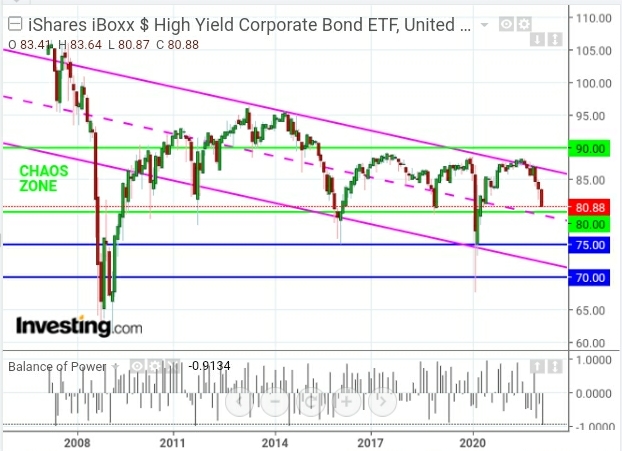
Depicted on the following monthly chart of the High Yield Corporate Bond ETF (HYG) are a long-term downtrending channel, several horizontal support and resistance levels, and a large sideways "CHAOS ZONE."

HYG's current push downward is accelerating and is fast approaching a confluence of price and channel median support around 80.00.

It has been trapped, for the most part, in a volatile and whippy "CHAOS ZONE" in between 80.00 and 90.00 since mid-2009.

A drop and hold below 80.00 on accelerating selling (depicted on the Balance of Power indicator and is now at an extreme level) could see it retest 75.00 or 70.00, or plunge even lower, in short order.

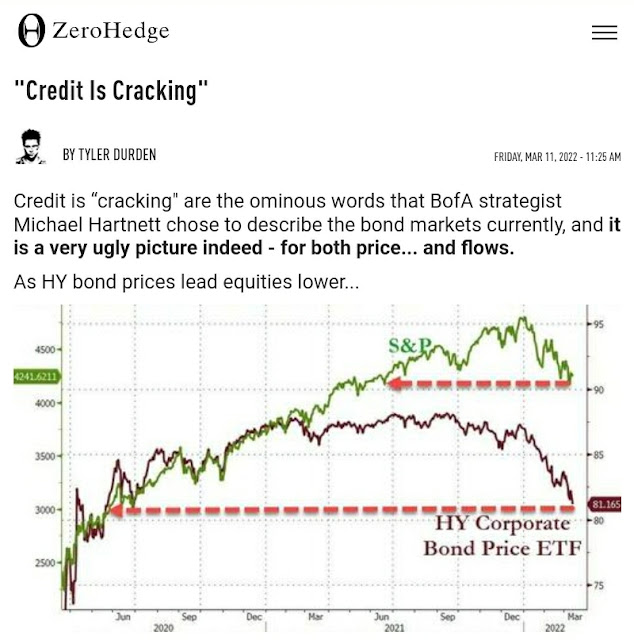
For further clues on possible direction, check out the following information.

The article below contains relevant and important details on HYG and the credit markets, and their potential impacts on equity markets...definitely worth a read.


Wednesday, March 02, 2022

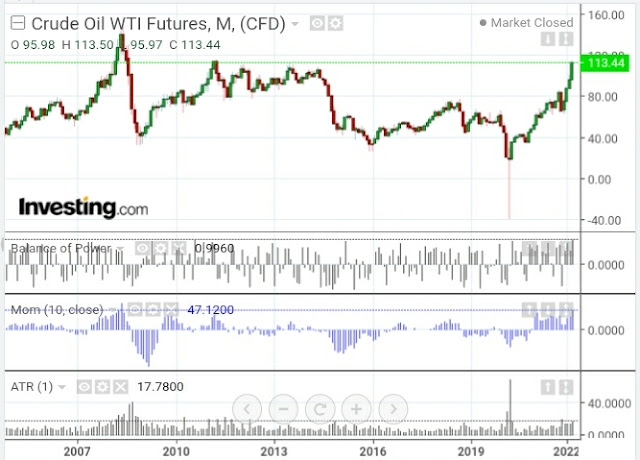
WTI CRUDE OIL: Price Targets 1 and 2 Hit...Target 3 In The Crosshairs

Further to my post of February 24, WTI Crude Oil took out price Target 2 (111.00-112.00) today, after blowing through Target 1 (100.00) yesterday.

It's currently trading above that level at 113.44, and rising, as I write this at 8:30 pm ET, as shown on the monthly chart below.

As I described in the above post, the "path of least resistance" is up (in fact, resistance is extremely thin above Target 2, as depicted on the TPO Profile of that chart), and Target 3 (147.27) is now in the crosshairs (to retest its prior all-time high).

Exactly how soon that may be hit remains to be seen, but the Buyers remain fully in control on this timeframe, as shown on the Balance of Power indicator. 

Furthermore, until we see an extreme spike made on both the Momentum and ATR indicators, as well as the Balance of Power, Oil may not have topped out yet. (By the way, I've shown the input value of the ATR as one period to illustrate this more clearly...the other two indicators are shown in their default mode).

So, we may see Target 3 hit sometime this month...possibly sooner, rather than later.


Monday, February 28, 2022

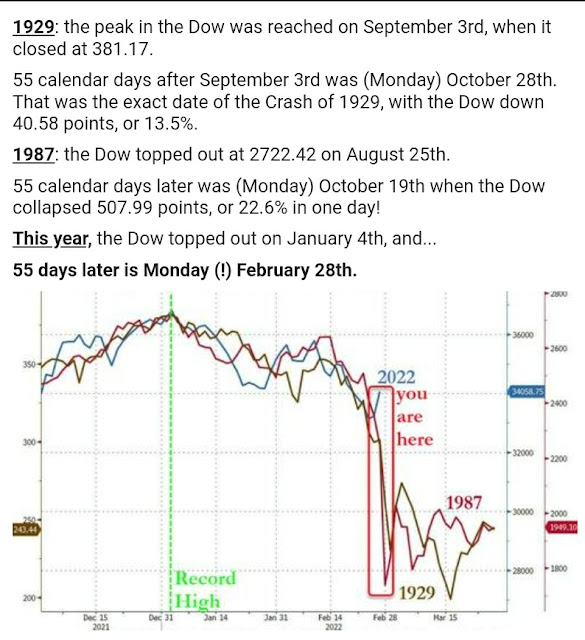
Is There A Dow Rule-Breaker Lurking on February 28? 😏

* See UPDATES below...

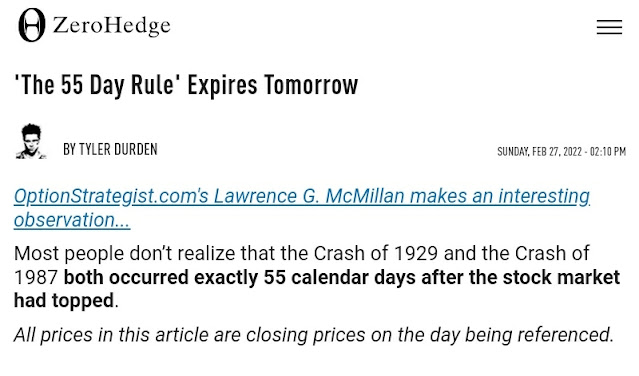
IF there is an "old" Dow rule-breaker lurking about somewhere in the ether, then Monday's trading should not end in a "Crash." 

OTHERWISE...brace yourselves if history repeats itself, as described in the following ZeroHedge article.

BUT...although the Dow 30 Index closed at its all-time high on January 4, it reached an intraday all-time high on January 5...so, 55 calendar days later could put the "Crash" date forward by one day to March 1.

SO...either way, we may (or may not) see a "Crash" on Monday or Tuesday...depending on whether the "old" rule-breaker shows up. 😏

* UPDATE February 28...

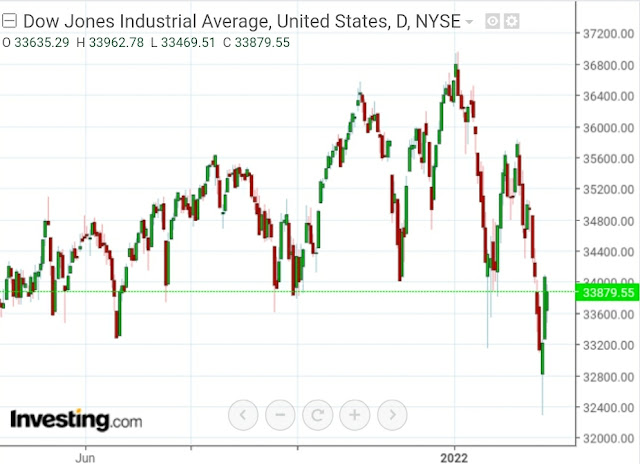
No "Crash" today...

* UPDATE March 1...

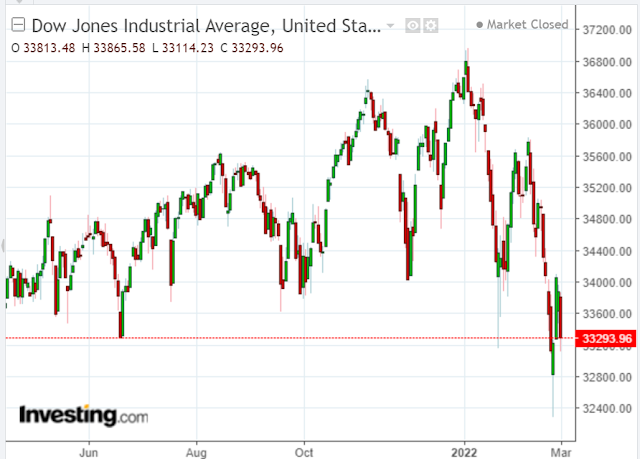
No "Crash" today, either...the "Old Guy" (Fed Chairman Powell???) is still around, for now...we'll see how long that lasts.

P.S. By the way, Chair Powell looked nervous and stressed as he testified before the House Financial Services Committee on March 2
His responses to various questions posed by Committee members pertining to rampant and rising inflation, as well as the oil and gas industry relative to Biden's climate change policies/agenda, sounded weak, wishy-wasy and ill-prepared. 
It didn't sound like the Fed is prepared to act in any meaningful or serious way to quickly tamp down inflation and its destructive consequences. It appears that they are more concerned with keeping markets over-inflated at record levels than they are at deploying their monetary policies in a sound manner, as their mandate so requires (lacking or ignoring serious predictive warnings)...if they were, I doubt that inflation would have reached current levels.

So, I may not be wrong in assuming that the "Old  Guy" who showed up in markets yesterday (and today) may, in fact, be Powell...or, rather his "silent influence."


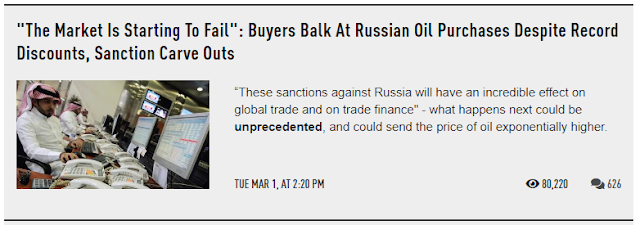
MEANWHILE...U.S. equity markets are clinging to and threatening to break below major support...so, stay tuned as things heat up in global Oil markets...and other areas of concern in which the Fed may be ill-prepared to act in a timely, effective and prudent manner.


Monday, October 05, 2020

U.S. Markets In One Word: Indecision

And, unlikely to resolve before the November 3rd Presidential election. Until then, 3350 is a key support/resistance level to monitor. Chaos and higher volatility lie below that price within the jaws of the "alligator."

SPX weekly

Sunday, July 05, 2020

SPX: Alligator's Jaw Shuts...Higher Prices Ahead?

Further to my post of June 29, the jaw of the William's Alligator has shut and two of the three moving averages (each offset into the future) have re-crossed and turned up, as shown on the following SPX daily chart.

As well, the Awesome Oscillator has flipped above the zero level.

Both of these are hinting that further buying may be in store...I'd need to see the third moving average turn up to confirm potential strength.

However, the Balance of Power is still with the sellers, albeit somewhat tepid, so, unless we see this flip to the buyers on this timeframe, we may be in for a bit more weakness before we see sustained buying resume.

Near-term support sits around 3070. If that's crossed, look for price to, potentially, re-test 3000, or lower.


Price on the following SPX:VIX ratio chart has broken back above 100 and the 50-day moving average, once again.

The RSI has crossed above the 50 level, the MACD has formed a bullish crossover, and the PMO is poised to cross to the upside.

We may see serious buyers step in on the SPX if:
  • price can remain above 3070
  • the AO remains above zero
  • the BOP flips from sellers to buyers
  • the RSI can hold above 50 on the SPX:VIX ratio
  • the MACD can hold its bullish crossover on the SPX:VIX ratio
  • the PMO forms a bullish crossover on the SPX:VIX ratio

Otherwise, we may see some minor selling on the SPX down to the 3000 level, or even a stronger effort to push it much lower toward 2800.


Monday, June 29, 2020

DANGER: Alligator Crossing on the S&P 500 E-mini Futures Index

Further to my post of June 21 with respect to the SPX, I'd just mention that the three moving averages (each offset into the future) forming the Williams Alligator on its counterpart S&P 500 E-mini Futures Index (ES) have all crossed to the downside, as shown on the following daily chart.

As well, the Awesome Oscillator has just turned negative in Sunday's overnight trading.

Both of these are signalling potential further weakness ahead.


Price on the following SPX:VIX ratio chart has slipped below 100, once again.

It needs to retake and hold above 100, the RSI needs to rise and hold above 50, and MACD and PMO bullish crossovers need to reform to signal potential sustainable SPX strength.

So, keep an eye on whether these ratio parameters can manifest, together with a rally and hold of the ES above 3075, plus a reversal and uncrossing of the Alligator moving averages to the upside, along with a reversal and hold of the AO above the zero level.

Otherwise, we may see more SPX selling to retest its June low of 2965.66, or lower.


Sunday, June 21, 2020

SPX Targets

Further to my post of June 15, the SPX pushed above 3080.20 to reach a high of 3155.53 on Friday, as shown on the daily chart below.

I've shown two Fibonacci Extensions (one taken from the March low and the other taken from the June low), as well as an Andrew's Pitchfork (taken from the March low), and a Williams Alligator (formed by three moving averages, each offset into the future).

There are two areas of price confluence zones (targets) above the current price. The first is a minor confluence zone around the 3250 level (where two of the Fib Extension levels converge). The second is a major confluence zone around 3350 (where two of the Fib Extension levels converge with the bottom of the Andrew's Pitchfork channel).

The SPX closed on Friday just above the upper-most moving average of the Alligator. As well, all three moving averages are either curled upwards or in the process of doing so, hinting of higher prices ahead. I'd like to see the momentum indicator reverse its negative reading and push through and hold above the zero level to confirm any rally higher to either of these price targets in the short term. 

Otherwise, we may see the SPX retest its June low of 2965.66, or lower.


Monday, June 15, 2020

SPX: In The Jaws Of The Alligator

As of today's close, the S&P 500 Index (SPX) is currently in the 'jaws of the alligator' -- Williams Alligator, to be precise, which is formed by three moving averages, each offset into the future -- as shown on the following daily chart.

All three moving averages are curling down and the upper one has just crossed below the middle one...hinting of further weakness ahead.  Today's low touched the lower MA, which roughly converges with the 23.6% Fibonacci retracement level. A break and hold below today's low of 2964.40, together with the crossing of the middle MA below the lower MA, could send the price down to the next Fibonacci retracement level (40%) at 2835, or even the 50% level at 2712.

Conversely, if today's high of 3080.20 (which is roughly the present level of the crossed upper and middle MAs) is broken and held, we could see the SPX push above the alligator's jaw and retest last week's high at 3233.13, or higher. Watch for the shortest MA to curl upwards, then the other two, to support higher prices.

The momentum indicator (MOM) has risen back above the zero level today. It's important that it remain above zero to support higher prices in the near term.

Sunday, May 17, 2020

U.S. Markets Emerging From Chaos

* See UPDATE below...

The following daily, weekly and monthly charts of the four U.S. E-mini Futures Indices show that they are at the emerging edge of chaos [which is defined by three future-offset moving averages (green 5MA, -3), (red 8MA, -5), and (blue 13MA, -8)].

In all of these three timeframes, the NQ is the strongest and is the most favoured to continue its rally, while the ES is next, followed by the YM and RTY.

In the short term, watch for all three of the moving averages to curl upwards on the daily timeframe (with the green above the red above the blue), and for price to break and hold above all of them, to confirm that a sustainable rally is supported.

In the medium term, watch for all three of the moving averages to curl upwards on the weekly timeframe (with the green above the red above the blue), and for price to break and hold above all of them, to confirm that a sustainable rally is supported.

In the longer term, watch for all three of the moving averages to curl upwards on the monthly timeframe (with the green above the red above the blue), and for price to break and hold above all of them, to confirm that a sustainable rally is supported.

As well, the NQ is the only index that is above both the 50 and 200 moving averages on all three timeframes. These two moving averages pose as resistance or support levels on the YM, ES and RTY on all three timeframes. Look for the YM, ES and RTY to eventually break and hold above both of these moving averages in order to support any further rally and breakout to new record highs by the NQ.

Furthermore, we're about to see a bullish Golden Cross form on the 50 and 200 MAs on the NQ daily timeframe. If that occurs and holds, we'll likely see the rally continue.

If the NQ fails to continue its bullish leadership, we may see all four indices drop to, potentially, new lows, especially if the NQ drops and holds below its 50-week MA (currently at 8245).

YM/ES/NQ/RTY Daily charts

YM/ES/NQ/RTY Weekly charts

YM/ES/NQ/RTY Monthly charts

As of Friday's close, the Balance of Power still rests with the bulls on the SPX, as shown on the monthly chart below.

If the BOP drops and holds below the zero level, that control will switch to the bears on this timeframe, and we may see the SPX drop to around 2675 (the apex of the expanding triangle), or lower.

SPX Monthly chart

The SPX:VIX ratio is holding above 80 and may be headed towards its next resistance level at 100, as shown on the following daily ratio chart.

All three technical indicators (RSI, MACD and PMO) are hinting of higher prices for the SPX.

Under that scenario, the RSI should hold above 50, and the MACD and PMO should begin to swing upwards.

SPX:VIX Daily ratio chart

SUMMARY

If I were a betting woman, I'd say that the SPX has around a 55% chance of moving higher over the coming days/weeks, albeit in a choppy and, sometimes, volatile manner.

Keep an eye on the information and charts that I've shown above as potential directional gauges in the days/weeks ahead.

* UPDATE May 18...

Here's how the U.S. Major Indices fared throughout the day and into the close...


SPX Monthly chart

SPX:VIX Daily ratio chart

Saturday, March 14, 2020

S&P 500 Index Daily, Weekly & Monthly Pivot Points

* See UPDATES below...

Further to my last post, the following pivot point calculations and charts are provided to illustrate a variety of support and resistance levels for three timeframes, namely daily, weekly and monthly, for the S&P 500 Index (SPX).

For a detailed explanation of pivot points, feel free to check out John Person's website at this link (the creator of this pivot calculator) and use his calculator for your own purposes. Just input the respective candle's high, low and close values to the second decimal point and press "submit."

Generally speaking, it uses the prior day's, week's, or month's high, low and close to calculate the following day's, week's, or month's Pivot Point (PP) and its resistance values above and its support values below. Price action above the PP is considered bullish, and below, it's bearish.

 SPX Daily Pivot Point Values (for Monday March 16)

SPX Weekly Pivot Point Values (for the WEEK of March 16)

SPX Monthly Pivot Point Values 
(taken from the MONTH of February for March)

For a quick way to view the PP (pivot point) of each timeframe, I've shown it in a one-period moving average (hlc3) cross format (blue) on each of the following daily, weekly, monthly, and last monthly charts.

Friday the 13th closed at 2711.02.

So, for example:

  • The daily PP for Monday March 16 is 2638.24 -- N.B. Friday closed above that value, as well as Thursday's PP at 2540.15, so it closed bullish on the day, as well as compared with the prior day.
  • The weekly PP for the week of Monday March 16 is 2687.4833 -- N.B. Friday closed above that value, so it closed bullish for the week, but still bearish below the prior week's PP at 3003.5434.
  • The monthly PP taken from February for March is 3067.86 -- N.B. Friday closed well below that level, so it is bearish on the prior month, so far. ***(NOTE that March's PP is currently 2772.7333, based on this month's trading action, thus far, and will change before month's end, the final value to be used for trading in April -- N.B. Friday closed below that value, so it is bearish on the current month, so far.)


SPX Daily chart 

 SPX Weekly chart

SPX Monthly chart 

I've included the following longer-term screenshot of the monthly price action of the SPX for the 21st century.

Shown on all of the four charts is the Average True Range (ATR) indicator with an input value of one period in histogram format to highlight extreme ranges, in particular.

The massive spikes in the February and March ATRs (on the monthly charts) have been unparalleled in range. They either represent capitulation or near capitulation that could produce a hefty bounce, or extreme fear that could continue to send the SPX plunging even further down.

I would hope that large-scale global monetary and fiscal stimulus measures that are currently being considered and/or taken by world central banks and governments would begin to calm markets down soon.

Hence, my providing the above daily, weekly and monthly pivot point support and resistance levels for possible tools to use in gauging market direction and strength for the SPX, as well as a Fibonacci retracement study taken from the December 2018 low to the February 2020 high (which also provides support and resistance levels within that trading range).

We may see price whipsaw within this 1,046.94-point trading range for quite awhile, until it stabilizes and eventually begins a new rally.

A drop and close below the low of the range could see catastrophic selling to the S1, S2 or S3 levels noted on the above three pivot point calculators.

Note that the Daily S3 level for Monday is 2346.19...virtually at the bottom of this range.

As an aside, I mentioned 2750 as a level of some importance on the corresponding S&P 500 E-mini Futures Index (ES) in my last post. It happens to coincide, roughly, with the SPX 60% Fibonacci retracement level of the trading range, R1 on the daily calculator, S1 on the monthly calculator, and the current PP of the March candle. It's not that far above Friday's closing price, so we may see some action around it on Monday.

SPX Monthly chart (21st Century)

In any event, volatility is likely to remain extremely elevated in both directions for awhile, until we eventually see a new series of higher swing highs and lows form on the SPX daily timeframe.

The following SPX:VIX daily ratio chart shows that price is still well below 60 (at levels seen during the peak of the 2008/09 financial crisis), as well as 100. I'd like to see it recapture and hold above 100, at least, before considering the possibility that volatility is settling down somewhat.

Furthermore, price is under the bearish influence of a recently re-formed moving average Death Cross, the RSI has yet to retake the 50 level, and the MACD and PMO indicators have yet to form bullish crossovers. So, we'll need to see reversals of those occur and hold, if price rallies to anywhere near 100, and beyond...and, if the SPX can retake and hold above 2750 and higher.

Otherwise, look out below!

SPX:VIX Daily Ratio chart

* UPDATES...

The S&P 500 E-mini Futures Index (ES) nearly tagged the SPX S3 level of the Daily Pivot Point calculations for Monday March 16 (see above). It made a low of 2350.88, while the SPX low was 2364.55.

Each candle on the following S&P E-mini cash chart represents a period of one quarter.

As of Monday's close, the current candle, Q1 of 2020, is a massive bearish engulfing candle and it has erased nearly all of the preceding trades since Q2 of 2017.

I've shown an ATR overlay on the chart (Average Trading Range), with an input value of one period (one quarter) to show the excessively and unprecedented extreme level it has now reached. As I mentioned above, this either represents capitulation or near capitulation that could produce a hefty bounce, or extreme fear that could continue to send the SPX plunging even further down.


So far, in spite of recent moves by various world central bankers and treasury departments, markets around the world continued to plummet on Monday, as shown on the following charts. Their respective percentages lost to date from February 19 are shown on the following graph.

It remains to be seen what global monetary and fiscal stimulus measures, as well as health conditions related to the coronavirus pandemic, are necessary before world markets begin to stabilize.

In any event, the above Pivot Point calculations for the Week and Month are still valid as support and resistance levels/targets for the SPX...ones to watch for the rest of this week.


N.B.

The SPX pivot point support and resistance values for Tuesday are:


The SPX pivot point support and resistance values for Wednesday are:


The SPX pivot point support and resistance values for Thursday are:


The VIX pivot point support and resistance values for Thursday are:


The SPX pivot point support and resistance values for Friday are: