WELCOME

Welcome and thank you for visiting!

The charts, graphs and comments in my Trading Blog represent my technical analysis and observations of a variety of world markets...
* Major World Market Indices * Futures Markets * U.S. Sectors and ETFs * Commodities * U.S. Bonds * Forex

N.B.
* The content in my articles is time-sensitive. Each one shows the date and time (New York ET) that I publish them. By the time you read them, market conditions may be quite different than that which is described in my posts, and upon which my analyses are based at that time.
* My posts are also re-published by several other websites and I have no control as to when their editors do so, or for the accuracy in their editing and reproduction of my content.
* In answer to this often-asked question, please be advised that I do not post articles from other writers on my site.
* From time to time, I will add updated market information and charts to some of my articles, so it's worth checking back here occasionally for the latest analyses.

DISCLAIMER: All the information contained within my posts are my opinions only and none of it may be construed as financial or trading advice...please read my full Disclaimer at this link.

Dots

* If the dots don't connect, gather more dots until they do...or, just follow the $$$...

Beach Drinks

Beach Drinks

ECONOMIC EVENTS

UPCOMING (MAJOR) U.S. ECONOMIC EVENTS...

***2026***
* Wed. June 17 @ 2:00 pm ET - FOMC Rate Announcement + Forecasts and @ 2:30 pm ET - Fed Chair Press Conference

*** CLICK HERE for link to Economic Calendars for all upcoming events.

Showing posts with label German DAX. Show all posts

Wednesday, March 15, 2023

CREDIT SUISSE BANK: From Bad To Worse

My post of November 4, 2011 contained a list of 29 banks that were deemed "Too Big To Fail" by the Financial Stability Board of the G20.

One of those banks was Switzerland's Credit Suisse Bank (CS). Another was Germany's Deutsche Bank (DB).

I last wrote about both of these banks in my post of October 3, 2022.

Their movements were identical from September 2001, and both were trading at or near their lifetimes lows...just above zero. They had never recovered from the fall from their lifetimes highs set in April 2007...right before the 2008/09 financial crisis.

My article contained a lot of information detailing their weaknesses, which were reflective of their credit risk in the face of an impending global recession.

Today, Credit Suisse is back in the news, as it has made a new lifetime low of 1.78, so far, today. Deutsche Bank also gapped down to a low of 10.06, thus far. Sellers are still firmly in control of CS, and have been for most of the time since its high of 73.01 made in April 2007, as shown on the following monthly comparison chart.

U.S. and European markets are down considerably today, on this news.


(World Markets at 2:15 pm ET)

The following ZeroHedge articles detail the issues facing, not only Credit Suisse, but "the entire European banking sector (stock and credit) [which] is cratering," at the moment.


ZeroHedge excerpt

ZeroHedge excerpt

ZeroHedge excerpt


ZeroHedge excerpt

So, will we see a bank bailout from the Swiss National Bank (Swiss Central Bank), or other entity...for CS and any other distressed European banks?

By the way, regardless of whether CS is bailed out, there's a reason why it's plunged to almost zero in value...and, I doubt whether throwing more money at it will change its trajectory, or merit, as a viable and trustworthy bank, in the long term.

Will that contagion spread to American banks, some of which are already collapsing, as detailed in my last post?

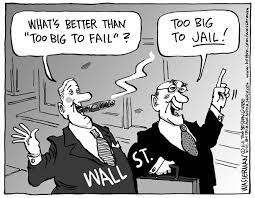
Why is reckless behaviour by bank executives continuously rewarded with bailouts by Central Bankers and governments around the world, at the expense of taxpayers...with no consequences?
N.B. On a related note, I compared the charts and price action of Germany's DAX with the EUFN (Europe's MSCI Financials ETF) several times last year, here (March 7, 2022) and here (July 16, 2022).

I warned of a strong divergence between the DAX and the EUFN in my March 7 post. I noted that, while the DAX had been in a long-term uptrend, the EUFN had been in a volatile and whippy general downtrend. It was a warning of weakness for the DAX (and the EUFN, as well as other European indices). Both plunged a great deal from then, until they bottomed in October, as shown on the following monthly comparison chart.

They've both rallied since then, but have come to a screeching halt and have reversed course this month. In fact, the EUFN has plummeted far worse than the DAX, so far. The Sellers are firmly in charge of EUFN.

If the EUFN continues to outpace the DAX on further downside movement, it's a signal that the DAX may follow soon, thereafter...both worth monitoring over the coming weeks and months, in addition to CS and DB.

* UPDATE March 18...

A takeover deal may be imminent, whereby UBS Group AG (UBS) acquires all or part of Credit Suisse...we'll see what happens...


Price action on the following monthly chart of UBS depicts the fact that this investment bank has never recovered from the negative fallout of the 2008/09 Financial Crisis

It's been trading in a sideways range between 10.00 and 23.00, since it bottomed in March of 2009..quite the switch from its record high of 66.26 set in April 2007.

The Balance of Power is currently in the hands of Sellers.

A break and hold above 23.00 could inspire confidence in this bank, if it did acquire CS, and entice new shareholders to place their bets accordingly.

However a break and hold below 10.00 could see this bank enter crisis territory and flop, as well.

One to watch over the coming days/weeks.

* UPDATE March 19...

The following ZeroHedge article provides further updates on the negotiations between UBS and CS...it seems a deal has been reached.

If the Swiss National Bank is prepared to assist in this acquisition with a sizeable monetary contribution, this must be a very dire situation, indeed!

Will this end in a nationalization of banks in Switzerland -- and, perhaps in other countries -- at some point...and end capitalism, as we know it?

* UPDATE March 20...

Swiss (and European) bond holders are not happy with the deal involving CS, UBS and the Swiss National Bank...

Swiss and European banks look weak, as shown on the monthly comparison chart of CS, UBS, DB and EUFN (European Financial ETF).

In fact, keep an eye on DB for signs of further weakness, as it struggles with problems associated with its CDS (credit-default swaps)...


Monday, October 03, 2022

CS & DB: Have You Ever Seen A More Perfect Union Of Banks On The Road To Zero?

* See UPDATES below...

The following monthly comparison chart illustrates the lock-step movements of Credit Suisse (CS) and Deutsche Bank (DB) since September 2001. 

Neither one recovered from the fall from their lifetime highs set in April 2007...right before the 2008/09 financial crisis.

They're both trading at or near their lifetime lows...just above zero.

No matter what pundits and bank executives say, and notwithstanding the fact that they were on the List of 29 Banks Deemed 'Too Big To Fail' by the G20 Financial Stability Board (published in November 2011), exactly how solvent are these banks, since charts don't lie?

Perhaps they funded one-too-many ESG company, or Bitcoin...the top 100 ESG companies are listed here.


The following monthly chart compares the Swiss Franc (CHF/USD) with the Euro (EUR/USD).

With some minor variations since October 1989, these currencies have traded in similar trajectories, as well. The Euro has experienced much more volatility and wild swings, while swings in the Franc have been tighter and more muted.

We'll see if the divergence of the lower monthly swing high set in the Euro in December 2020, versus the higher swing high of the Franc (leading to the sharp decline of the Euro below parity with the USD and to a lower swing low), will, eventually, drag the Swiss Franc below parity and a new swing low, as well.

Such a scenario [a CHF plunge to a new swing low (below its large sideways trading range) and hold below USD parity] could spell the downfall of Credit Suisse and, potentially, Deutsche Bank.

The following ZeroHedge article offers some insights relative to problems at Credit Suisse.


ZeroHedge excerpt

* UPDATE Oct. 5...

So, has CS bottomed? We'll see what happens. 

Either way, their chart is portraying severe weakness...presumably reflecting credit risk, which is not something that should be ignored in the face of an impending global recession.

* UPDATE Oct. 14...

So, this latest news is interesting...


ZeroHedge excerpt

ZeroHedge excerpt

Keep an eye on CHF/USD and on CS for developments.

At the moment, they are both down on the day, while CHF/USD is down on the month and CS is slightly off its October low.


BUT...no Fed panic...yet...

* UPDATE Nov. 23...

So far, the cash exodus from Credit Suisse in Q4 has been massive and historic...with no end in sight.


ZeroHedge excerpt

Its stock, CS, has plunged, once again, to 3.83 this morning, retesting September's low, with virtually no support below, except last month's record low of 3.70.


Saturday, September 24, 2022

GLOBAL MONEY FLOW: Cash & Crash

I've written a number of posts in the last few months regarding the MSCI World Index and the SPX, several of which are here and here, respectively, (together with subsequent updates) warning of further market crashes.

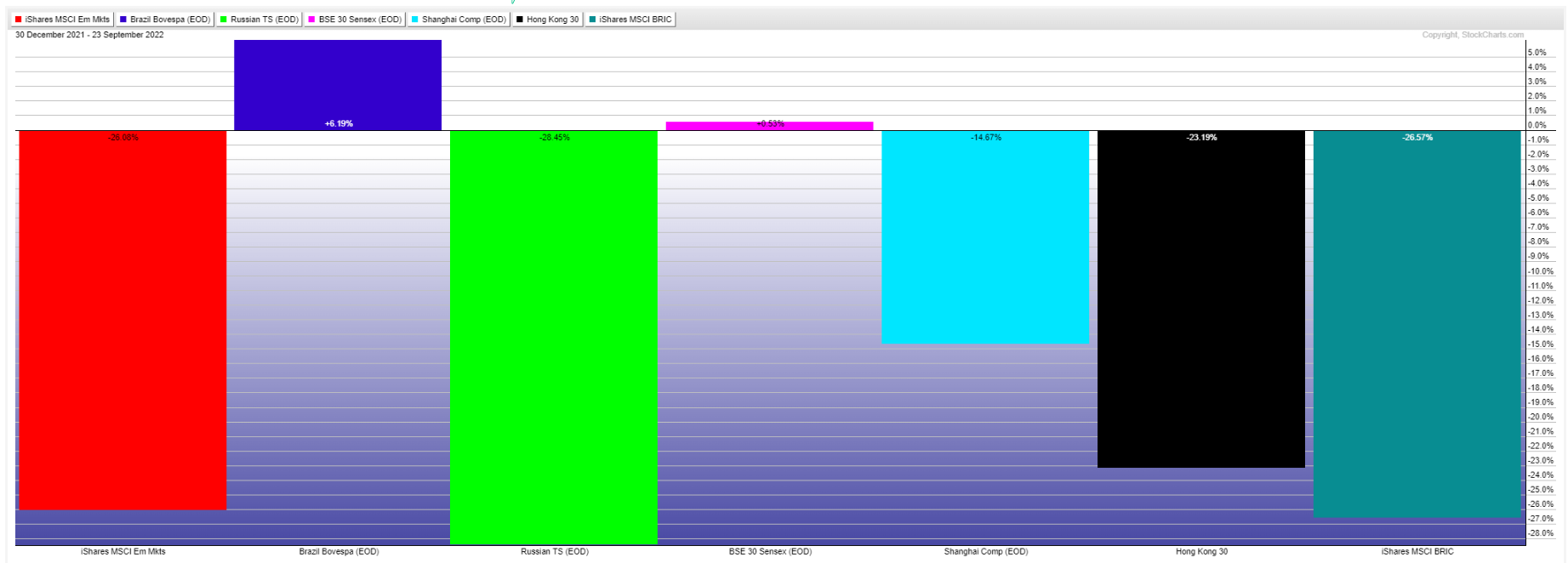
The following Year-to-Date and One-Week Percentages Lost/Gained graphs clearly depict, at a glance, global money flow for 2022 and for the past week (graphs courtesy of StockCharts.com).


MONEY FLOW YEAR-TO-DATE


U.S. Major Indices

U.S. Major Sectors

European Major Indices

Canada, Japan & Australia Major Indices

Emerging Markets ETF, BRIC Major Indices & BRIC ETF

Commodity & Agriculture ETFs & Commodities

Currencies, BITCOIN, XLF, EUFN & GXC

MONEY FLOW SEPT. 19-23


U.S. Major Indices

U.S. Major Sectors

European Major Indices

Canada, Japan & Australia Major Indices

Emerging Markets ETF, BRIC Major Indices & BRIC ETF

Commodity & Agriculture ETFs & Commodities

Currencies, Bitcoin, XLF, EUFN & GXC

SUMMARY

Overall, the biggest winners have been:

  • the Oil and Gasoline sectors, 
  • as well as the U.S. Dollar.

The biggest losers have been:

  • Bitcoin, 
  • global equities (especially U.S., China, Russia, Europe and the emerging markets ETF, EEM), 
  • global Financial ETFs (U.S., Europe & China), 
  • foreign currencies, 
  • U.S. Bonds, 
  • copper & precious metals, and
  • U.S. Discretionary, Technology, Materials and Financial Sectors.

During the past week, there has been:

  • continued buying of the U.S. Dollar, 
  • continued selling of Bitcoin, 
  • some selling in Oil and Gasoline,
  • accelerated selling of the British Pound, the Euro, Aussie Dollar and Canadian Dollar,
  • accelerated selling of the U.S., European and Chinese Financial ETFs (XLF, EUFN and GXC), and
  • accelerated selling of global Major Indices (including U.S.), and U.S. Major Sectors.


CONCLUSIONS

All in all, I see no pivot away from U.S. Dollar strength and global equity and sector (and Bitcoin) weakness...YET.

So, for the moment, U.S. cash is king, as the U.S. Fed has signalled its intent to continue raising interest rates and keep them elevated for some time after inflation has declined to the Fed's 2% maximum inflation target...which could last well into 2025.

*********

P.S. After I published this post, I came across the following article...which, interestingly, confirms my conclusions...

And, more analysts' opinions...